
At ACR Convergence 2025 in Washington, DC, something became clear: the question Steritas posed four years ago about measuring and reducing steroid-toxicity has become a framework, shifting how clinicians and patients approach steroid use.
The data tells the story, but the community made it real.
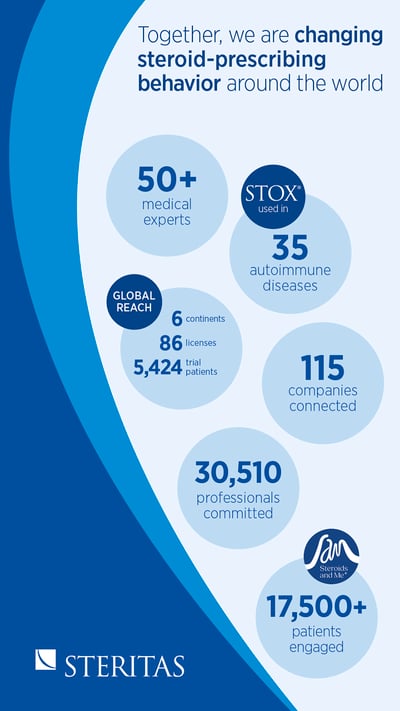
In 2021, Steritas set out to quantify what the clinical world had long recognized but rarely measured: steroid-toxicity. Today, the STOX® Suite is used to track patient outcomes across 35 autoimmune diseases, from asthma to lupus, inflammatory bowel disease to vasculitis. What began as a validated measure has become a clinical movement.
The numbers reflect the scale of engagement. More than 50 medical experts across multiple subspecialties helped shape the use of the STOX Suite in clinical research and practice. Their expertise turned academic rigor into practical knowledge, spanning six continents and 86 clinical trials involving 5,424 patients. Beyond the clinic and the trial site, the reach extends further. Over 30,000 professionals have engaged with the steroid-toxicity framework, applying it in practice, research, and conversations with patients. And crucially, more than 17,500 patients have used Sam® (Steroids and Me) to better understand and advocate around their own steroid burden.
These are not passive metrics. Clinicians are integrating STOX into treatment decisions, researchers are differentiating steroid side effects from treatment effects in trials, and patients are armed with practical tools to participate in shared decision-making about their care.
From awareness to anticipated label claims
The trajectory has been swift. From 2021's foundational work building awareness of steroid-toxicity as a distinct clinical entity, to an increasing number of clinical trials reporting out data that include the measurement of steroid-toxicity using the STOX Suite.
The next milestone is already taking shape: steroid-toxicity reduction language in drug labels. As regulatory bodies increasingly recognize the clinical and economic burden of steroid-related adverse events, the capacity to measure and communicate the value of steroid-sparing therapies is firmly in place.
Looking forward
As 2026 approaches, the work continues. New disease indications are being mapped. More trials are integrating STOX endpoints. Additional patients are discovering Sam as a tool to understand their treatment journey. And the conversation about steroid-toxicity is shifting from "should we measure this?" to "how do we use this measurement to improve outcomes?"
The momentum is undeniable. The infrastructure is built. And the community that made it possible continues to drive progress.
Thank you for being part of this journey.